
The Most Important Skills for Robotics Engineers

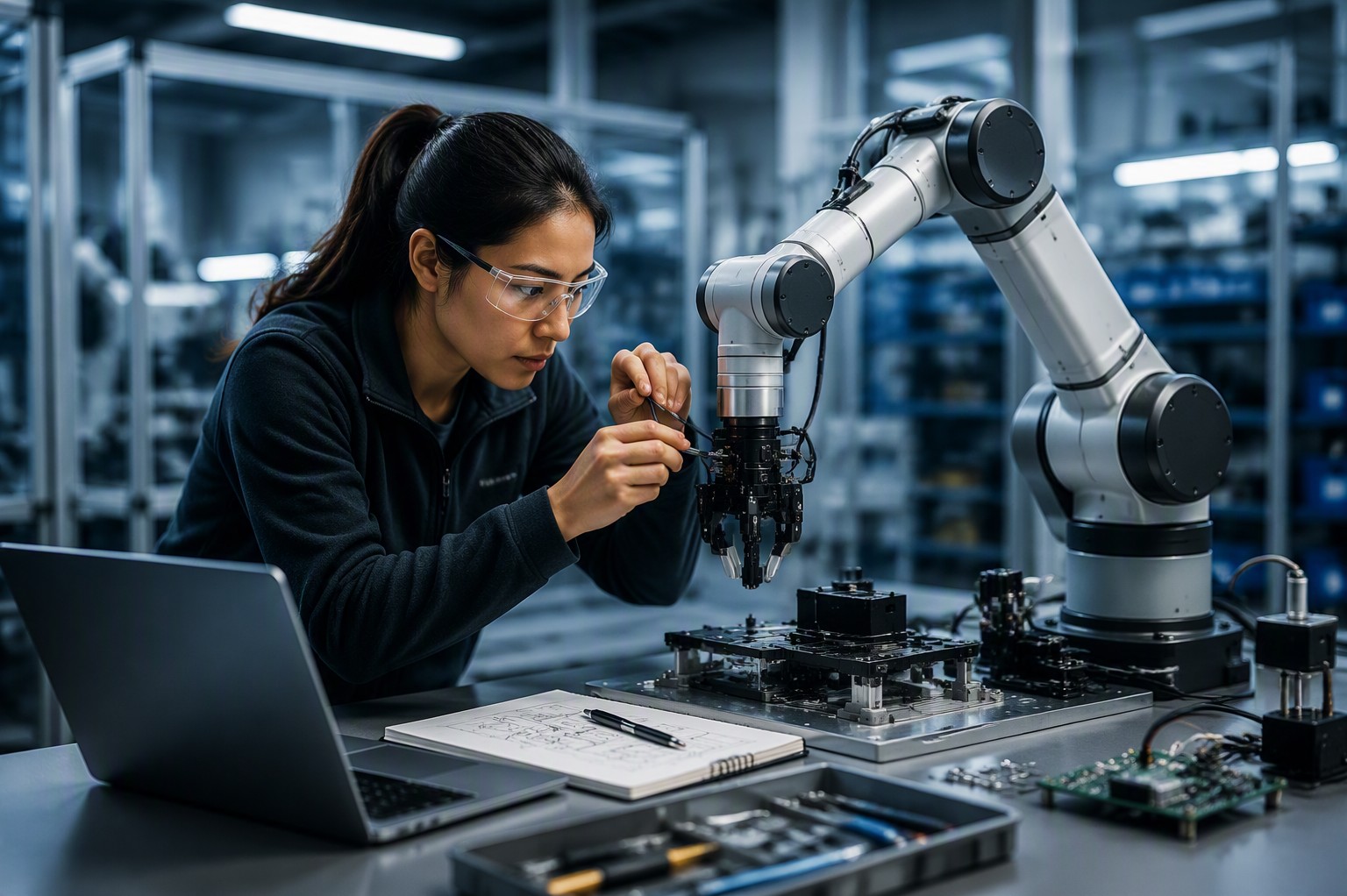
Robotics is becoming an increasingly important part of modern manufacturing. According to the International Federation of Robotics, global demand for industrial robots has doubled over the past decade as manufacturers invest more heavily in automation and collaborative robots (cobots).
That growth is creating opportunities for engineers with skills across software, electronics, mechanical design and control systems. Employers still need specialists, but they also need people who understand how their work affects the rest of the machine.
Here, we look at the robotics engineering skills employers value most and how candidates can demonstrate them when applying for robotics engineering jobs.
What does robotics engineering involve?
Robotics engineering covers the design, development, programming and testing of machines that can sense their surroundings and carry out physical tasks autonomously or semi-autonomously.
The work varies considerably between roles and technologies. One engineer might design an actuator (electric motor, hydraulic cylinder, etc) or end effector (the claw that picks up products), while another develops the software that controls movement or processes data from cameras and sensors. Other robotics engineering jobs focus on embedded systems, electronics, machine vision, controls or full-system integration.
Although these areas require different expertise, they cannot be treated in isolation. A mechanical design may look sound in CAD but leave a camera with a restricted field of view. A control algorithm may perform well in simulation but struggle once vibration or uneven surfaces are introduced.
Employers therefore value engineers who have depth in their own discipline and can also see how their decisions impact the wider system.
Why are robotics engineering skills becoming broader?
As robotic systems become more intelligent and autonomous, the boundaries between mechanical, electrical and software engineering are becoming less distinct. Modern robots are increasingly expected to operate with minimal human supervision, adapt to changing environments and make decisions based on real-time sensor data. That makes the relationship between hardware and software more important than ever.
A robotics software engineer may never design a robot's physical structure, but an understanding of movement, kinematics, motor control and physical constraints can help them write more reliable software. A mechanical engineer may not develop the perception stack, but should understand what cameras, sensors and AI algorithms can influence critical design decisions.
This growing overlap does not mean employers are looking for one person to master every discipline. Instead, organisations typically look for strong specialists who can collaborate effectively across team boundaries, understand how their work affects the wider system and communicate with engineers from different technical backgrounds. In complex robotics and automation projects, this systems-level thinking is often as valuable as deep technical expertise.
Which technical skills do robotics engineers need?
The exact requirements depend on the product, but many robotics engineer jobs require a combination of the following technical skills:
- C++ and Python programming
- Linux-based software development
- ROS or ROS 2 (Robot Operating System)
- Embedded software and firmware
- 3D CAD and mechanical design
- Sensors, actuators and motor control
- Electronics and PCB fundamentals
- Control systems and industrial automation
- Computer vision and machine learning
- Simulation, testing and data analysis
Few robotics engineer vacancies require advanced expertise in every area. Employers are normally looking for candidates with strong skills in one or two core disciplines, supported by a broader understanding of how robotic systems are designed, integrated and deployed in real-world environments. The most successful robotics engineers combine specialist knowledge with the ability to work across mechanical, electronic and software domains when solving complex engineering challenges.
Programming skills for robotics engineer jobs
Software is at the heart of modern robotics. It controls how a robot moves, interact with their environment and respond to changing conditions in real time. It may also handle route planning, object recognition, fleet coordination or fault management.
C++ is widely used where speed, timing and control over system resources matter. Python is common in prototyping, testing, data analysis and machine learning. Linux experience is also valuable because many robotics development environments are built around it.
Knowledge of the Robot Operating System can be particularly useful. ROS and ROS 2 provide tools and libraries that help teams connect hardware, sensors and software without building every part of the system from scratch.
The most relevant language or framework will depend on the role. An embedded robotics engineer may work closely with motors and real-time hardware, while an autonomy engineer may focus more on perception, navigation and sensor fusion.
Mechanical design and electronics skills in robotics engineering
Even the most advanced robot still has to move, grip, lift or steer. Mechanical design remains central to how safely and reliably it can perform those tasks.
Mechanical robotics engineers may work on frames, joints, actuators, grippers or complete platforms. Employers often look for experience with 3D CAD, production drawings, tolerance analysis, GD&T (Geometric Dimensioning and Tolerancing) and design for manufacture.
The operating environment has to shape those decisions. A warehouse robot needs to move safely and reliably around people and stock, while an inspection robot may have to cope with confined spaces or extreme temperatures. In both cases, the design has to be accurate enough for the task while remaining practical to manufacture and repair.
Electronics knowledge is equally important. Robots rely on sensors, motor drives, power systems, communications and embedded processing. An engineer may not design every circuit, but they should understand how the hardware connects and how decisions around power or component placement may affect performance elsewhere.
Why systems thinking matters in robotics engineering jobs
When a robot behaves unexpectedly, the first explanation is not always the correct one. Poor movement could come from software, an inaccurate sensor reading, mechanical play, electrical noise or a timing issue between subsystems.
Systems thinking helps engineers investigate the machine as a connected product rather than assuming the fault belongs to one discipline. It also reduces the risk of solving one problem while creating another.
This becomes especially important when a robot moves from prototype to production. A successful demonstration proves that an idea can work, but a commercial product must also perform consistently and safely. It needs to be manufactured reliably and maintained once it’s in use.
What soft skills do robotics engineers need?
Robotics development is highly collaborative. A single product may involve mechanical engineering, electronics, embedded software, machine learning, vision and manufacturing teams.
Clear communication allows those groups to make decisions without losing important technical detail. Engineers need to explain what they’ve found and raise concerns early enough for the team to act.
Problem-solving is just as important as technical expertise. Robotics engineers often work on faults without an obvious cause, so they need to break the issue into smaller tests and adjust their approach when the results point somewhere new.
Employers also value ownership and the ability to give and receive technical feedback. These qualities affect how well an engineer contributes to a multidisciplinary team.
How to demonstrate robotics engineering skills when applying
A list of technologies tells an employer what you’ve used. A strong technical CV shows how you applied them.
When applying for robotics engineer jobs, explain the machine or subsystem you worked on, the problem you were trying to solve and your own contribution. Include the outcome where possible. That might mean improving positional accuracy or helping a prototype reach field testing.
University projects, personal builds, competitions and open-source contributions can also provide useful evidence, particularly for candidates moving into robotics from other disciplines.
Find robotics engineering jobs with Redline Group
Robotics employers need engineers whose experience fits the product, technology and the technical challenge at hand.
At Redline Group, we change lives every day by building world-class teams for technology companies. With more than 40 years of experience across engineering, electronics and software recruitment, our consultants understand the specialist skills behind robotics and automation.
Whether you’re exploring robotics engineering jobs or looking for the next step in your career, Redline can help you find opportunities that match your experience. Browse our latest engineering and technical jobs or see our client offering to find your next specialist.
Or contact Redline Group on 01582 450054 or email info@RedlineGroup.com.
